Guides
Suitcases and Trolley Bags: History, Types and How Luggage Is Made
What is a trolley bag? Learn how the suitcase evolved, hard vs soft luggage, cabin and check-in sizes, two vs four wheels, locks and how luggage is made.
Key takeaways
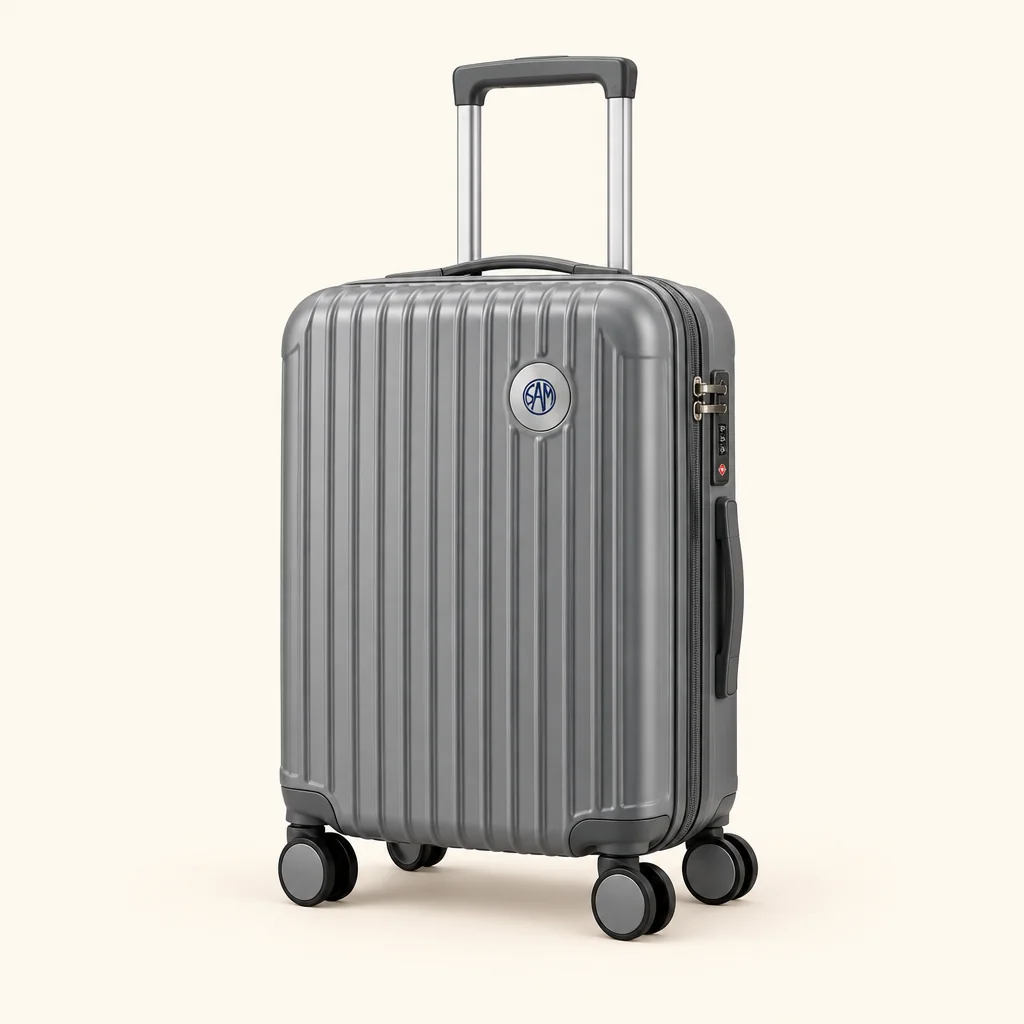
- A suitcase is a rectangular case with a handle for carrying your clothes and things while you travel. A trolley bag is a suitcase with wheels and a pull handle.
- Suitcases first showed up in the late 19th century with rail and ship tourism. Wheels were added in 1970, upright two-wheel rollers came in 1987, and the first four-wheel spinners were sold in 2004.
- Hard shell luggage is usually polycarbonate, ABS, polypropylene or aluminium. Soft luggage is usually nylon or polyester fabric over a frame.
- In India a cabin trolley is commonly around 55 cm tall, a medium check-in about 65 cm and a large about 75 cm. But it's always the airline's current allowance that decides what you can carry.
- Wheels, the handle system and zips are where trolley bags fail first, so check those before you worry about shell material or colour.
What is a suitcase or trolley bag?
A suitcase is a rectangular case with a handle that you carry your clothes and belongings in when you travel. A trolley bag is a suitcase with wheels and a telescopic pull handle, so you roll it instead of lifting it. In India people often use the two words for the same thing, and most suitcases sold today are trolleys anyway.
The Wikipedia entry on the suitcase describes it much the same way: a fairly flat, rectangular case that opens on one side and has a carry handle. A trolley adds three parts to that basic box. There are wheels at the base, a handle that slides out of the back, and a frame inside that holds both firmly.
It's not the same as a duffel, which is a soft, unstructured bag you carry by hand or on your shoulder. Nor is it a travel backpack, which you wear on your back. You can browse wheeled styles in our luggage collection, soft bags in duffels and carry-on packs in travel backpacks.
Where did the suitcase come from?
Before suitcases, travellers mostly packed into trunks made of wood and leather. Strong, yes. But heavy, and you needed porters and carts to move them. Even the word "luggage" comes from "lug". Wikipedia notes the Oxford English Dictionary recorded it in 1596, which tells you a lot about how travel felt for centuries.
The first suitcases turned up in the late 19th century, when mass tourism by rail and ship took off. They were meant to hold dress suits without creasing them, and that's where the name comes from. Early ones were leather or steel. From the 1930s, lighter materials like plastic and cardboard came in.
Wheels came surprisingly late. Wikipedia credits Bernard Sadow, a vice president at an American luggage company, with putting casters on a suitcase in 1970, after he saw a worker roll heavy machinery through an airport. A large New York department store started selling it in October 1970, and he got a patent in 1972.
| When | What changed |
|---|---|
| 1596 | The word "luggage" is recorded by the Oxford English Dictionary |
| Late 19th century | First suitcases, for rail and ship travel, made of leather or steel |
| 1930s onward | Lighter materials such as plastic and cardboard come into use |
| 1950 | A German maker sells the first aluminium suitcase |
| 1970 | Bernard Sadow adds casters to a suitcase, patented in 1972 |
| 1987 | Airline pilot Robert Plath invents the upright two-wheel rolling style |
| 1993 | An extendable handle is patented |
| 2000 | A German luggage maker produces the first polycarbonate suitcases |
| 2004 | The first four-wheel spinner suitcase is sold |
| 2010s | Smart suitcases with GPS and charging become popular, then face airline restrictions |
Sadow's design rolled flat on four wheels and was pulled along by a strap. Then in 1987 an American airline pilot, Robert Plath, came up with the upright two-wheel style that you tip onto its wheels and pull by a handle, and that replaced the flat design. An extendable handle was patented in 1993. The first four-wheel spinner went on sale in 2004.
The latest chapter is the smart suitcase, with GPS tracking and a built-in battery for charging your phone. They got popular in the 2010s. But lithium-ion battery fires led many airlines, in the late 2010s, to ban checking them in unless the battery comes out. If you've got one, take the battery out before you check the bag in.
Hard shell or soft luggage: which is better?
Neither one wins for everybody. Hard shell luggage protects what's inside better, keeps rain out and stacks neatly, but it won't squeeze into a tight overhead bin and it shows scuffs. Soft luggage flexes, usually has outside pockets and often expands. It just doesn't protect as well against crushing.
Polycarbonate
Polycarbonate is a tough thermoplastic that takes impacts well. A polycarbonate shell tends to flex when it's knocked and spring back instead of cracking. That's why it's so popular for check-in luggage, which gets thrown around.
ABS
ABS, or acrylonitrile butadiene styrene, is a common rigid thermoplastic. It's generally cheaper than polycarbonate but less impact resistant, so a hard knock can crack it. Some shells blend the two to balance cost and toughness.
Polypropylene, aluminium and fabric
Polypropylene is a light plastic that bends instead of breaking. Aluminium's very strong and looks premium, but it's heavier and it dents. Soft-sided luggage uses woven nylon or polyester, often with a water-resistant coating, stretched over a frame.
| Material | Weight | Impact behaviour | Scratches and dents | Best for |
|---|---|---|---|---|
| Polycarbonate | Light | Flexes and recovers, tough | Scuffs show on glossy finishes | Frequent flyers, check-in bags |
| ABS | Light | Rigid, more likely to crack under a hard knock | Scuffs show | Occasional travel, cabin bags on a budget |
| Polypropylene | Very light | Bends rather than breaks | Textured finishes hide marks | Light packers, cabin bags |
| Aluminium | Heavier | Very strong, can dent | Dents are permanent | Premium and equipment travel |
| Nylon or polyester (soft-sided) | Light to medium | Absorbs knocks, less crush protection | Fabric hides scuffs, can tear or fray | Overpackers, road and rail trips, outside pockets |
So, polycarbonate vs ABS luggage, in short? Polycarbonate is tougher and better if you check bags in regularly. ABS is fine for the odd trip and a tighter budget.
What size trolley bag do you need: cabin, medium or large?
Trolley sizes are usually given as height in centimetres, wheels and handle included. In India you'll mostly see these three.
| Size | Typical height | Usually used as | Good for |
|---|---|---|---|
| Cabin | About 55 cm | Hand luggage | Short business trips and weekends |
| Medium | About 65 cm | Check-in | A week away, or a family's shared bag |
| Large | About 75 cm | Check-in | Long trips, study abroad, moving home |
Use these as a starting point, not a rule. Every airline sets its own limits on cabin bag size and weight, and on how much checked baggage you can carry, and they change with the route and fare type. Wikipedia's pages on hand luggage and baggage allowance explain how allowances work, either by weight or by piece. Always check your airline's current allowance before you fly.
Two wheels or four wheels?
Two-wheel trolleys are the upright rolling kind. You tilt the bag and pull it behind you. The wheels are usually bigger and set into the body, so they handle broken pavements, kerbs and station platforms better, and there's less to snap off.
Four-wheel spinners stand upright and roll in any direction. You push them along beside you with almost no weight on your arm. They're easy in airport terminals and narrow aisles. On rough ground, though, the exposed wheels can catch, and on a slope or a moving train they'll roll away.
- Go for two wheels if you often walk on uneven roads, take trains and buses, or want a sturdier wheel setup.
- Go for four wheels if you mostly fly, move through smooth terminals and want the lightest feel on your arm.
- Check the wheels either way. Double spinner wheels roll more smoothly than single ones, and wheels with a bit of rubber or cushioning are quieter.
What kind of lock does a trolley bag need?
Most trolley bags come with a built-in combination lock. You set a three-digit code and turn the dials to lock the zip pullers in place. Some soft bags just have lockable zip pullers, and you add a small padlock.
A TSA-style lock is a combination lock that airport security in some countries, the United States in particular, can open with a master key to inspect your bag without breaking the lock. If you're flying to or through airports like that, it saves you a cut lock. For domestic travel in India, an ordinary combination lock's usually enough.
Be realistic about what a luggage lock does. It puts off casual opening and stops zips sliding apart in handling. It isn't a safe. Keep valuables, medicines and documents in your hand luggage.
How a trolley bag is made, step by step
Hard and soft trolleys start out differently but finish the same way. Broadly, this is the order luggage gets built in.
- Design and sizing: the maker fixes the outer dimensions, capacity, wheel type, handle height, material and where the branding goes, then gets the moulds or patterns ready.
- Shell moulding or panel cutting: for hard luggage, plastic sheet or pellets are heated and formed into the front and back shell halves in a mould, then trimmed. For soft luggage, nylon or polyester fabric is cut into panels, often backed with foam or board to hold the shape.
- Next comes the frame and handle system. A metal or plastic frame is fixed inside the back shell or panel, and the telescopic handle tubes are attached to it so the pull handle runs straight and locks at each height.
- The wheel housings are fixed to the base corners, usually riveted or screwed through the shell into reinforcing plates. This is where the bag takes every single bump.
- Zips and expander: the zip that joins the two halves is stitched onto a fabric band around the opening. Many bags add a second expander zip that opens out a few extra centimetres of depth.
- Then the lining goes in, with zip pockets, a divider panel and cross straps that hold clothes in place when you open the bag.
- Branding is added next: a logo plate, embossed badge, printed mark or embroidered patch, depending on the material.
- Inspection and testing: finished bags are checked for how the zip runs, the handle locks, the wheels roll and the finish looks. Across the industry, luggage designs are also tested by dropping, pulling and rolling them over and over to see how the wheels, handles and shells hold up.
Notice that the moving parts (wheels, handle and zips) are the ones that wear out. That's why they matter more than shell colour when you're buying. Our guide on how to identify a good quality bag goes into zip and stitch checks in more detail.
How to choose a good trolley bag
Buying one bag for yourself, or a few hundred for a team? Either way, check these in the shop or as soon as the parcel arrives.
- Handle: pull it all the way out and wiggle it. A little play is normal, but it should lock firmly at each height without rattling.
- Wheels: roll the bag across the floor in a straight line and then in a circle. They should turn smoothly and quietly, no wobble.
- Run the main zip all the way round. It shouldn't snag, and the teeth should look even and solid.
- Press the middle of a hard shell. It should flex and spring back, not crease. On a soft bag, check the seams and pocket corners instead.
- Weight when empty: a lighter bag leaves more of your allowance for packing, and that matters most with cabin bags.
- Look inside for packing straps, a divider and at least one zip pocket for small things.
- Warranty: see what's covered, especially wheels and handles. Our warranty page explains how ours works.
Ready to pick one? You can buy bags online with delivery across India. And our round-up of the best bags for every need shows which bag suits which kind of trip.
Looking after a trolley bag
Luggage takes a beating. A few habits will add years to it, though.
- Wipe hard shells with a soft damp cloth and mild soap. Harsh solvents can dull or weaken the plastic, so skip them.
- Soft luggage: brush off the dust and spot clean with mild soap. Don't put it in the washing machine.
- Wheels: pull out hair and threads wound round the axles, and wipe off grit after a muddy trip.
- Push the handle all the way in before check-in, and never lift the bag by the extended handle.
- Dry it before storing: after monsoon travel, open the bag up and let it dry completely in the shade, so you don't get mildew and smells.
- Store bags somewhere dry, nest smaller ones inside bigger ones, and leave the zips slightly open so air can get in.
Can you order trolley bags in bulk for gifting or tour groups?
Yes. Trolley bags make a great corporate gift for long-service awards, sales incentives and leadership offsites, because a good suitcase gets used for years. Tour operators, pilgrimage groups, sports teams and schools on exchange trips order matching luggage too, so the group's bags are easy to spot.
For a bulk order, settle the size first (cabin trolleys suit most gifting). Then pick the shell or fabric, the colour and where the logo goes. Pair cabin trolleys with a travel backpack or a duffel and you've got a complete travel kit. If you'd like a soft bag in the set, our duffel bags guide will help.
How SAM supplies luggage and travel bags
If you're buying for yourself, our luggage and travel bags are available online with free delivery across India, cash on delivery and a warranty. For organisations, here's how a bulk order works with us.
- Bulk orders start at 25 pieces, and you can mix trolleys, duffels and backpacks in one order so they all count together.
- Sample first: we send a physical branded sample for you to approve before the full run starts.
- Branding can be embroidery, screen printing, heat transfer, woven or rubber patches, or metal badges.
- We inspect every piece for stitching, zips and finish before dispatch.
- Dispatch and billing: dispatch is usually 7 to 21 days after sample approval, confirmed in your written quote, and bulk orders come with a GST invoice. One order can go to several addresses.
Sorting out luggage for a tour group or team trip? Start with our bulk travel bags page, or see corporate gift bags for employee and client gifting.
Sources and further reading
- Suitcase, Wikipedia
- Polycarbonate, Wikipedia
- Acrylonitrile butadiene styrene, Wikipedia
- Hand luggage, Wikipedia
- Baggage allowance, Wikipedia