Guides
Duffel Bags: Where the Name Comes From, Uses and How They Are Made
What is a duffel bag? Learn where the name comes from, how duffels are used, duffel vs suitcase vs backpack, materials, how one is made and how to choose well.
Key takeaways
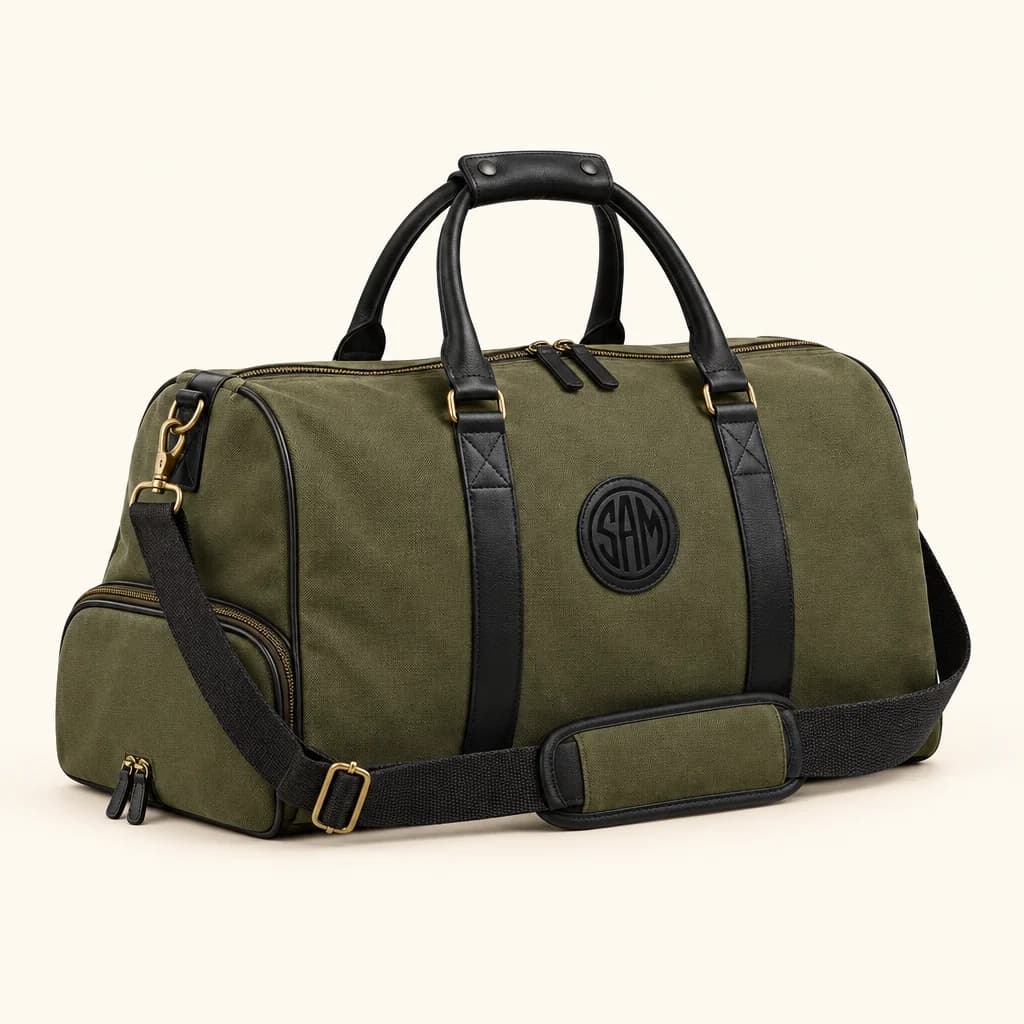
- A duffel bag is a big fabric bag, usually canvas or nylon, with a rectangular base, a zipped top opening, two handles and a shoulder strap that's often removable.
- It's the same bag people call a gym bag or carryall in American English, and a sports bag, holdall or kit bag in British English.
- Most sources say the name comes from Duffel, a town in Flanders, Belgium, where the thick duffel cloth originated in the 17th century. The Oxford English Dictionary dates the word to 1649 and duffel bag to 1768.
- Early duffels closed with a drawstring. Modern ones use a long top zip, webbing handles and a shoulder strap, and some add wheels and a telescopic handle.
- You judge a duffel at its stress points: the handle joints, the strap hooks and the top zip. Check those before you buy one bag, or a few hundred.
What is a duffel bag?
A duffel bag is a large bag made from natural or synthetic fabric, typically canvas or nylon, with a rectangular base, a zipped opening along the top, two carry handles and a shoulder strap that's usually removable. It's the long, soft bag you pack for the gym, a cricket match or a weekend away. Some duffels have wheels and a telescopic handle too.
The Wikipedia entry on the duffel bag gives it several names. Americans often say gym bag or carryall, and in British English it's a sports bag or holdall. Kit bag is common as well. In India you'll hear hold-all, especially in schools and the services.
What sets a duffel apart from other luggage is that there's no rigid frame. It's one big compartment that takes the shape of whatever you put in, and it squashes almost flat when it's empty. You can see current styles in our duffel bag collection.
Where does the name duffel come from?
Nobody's completely sure, but most sources tell the same story. The name comes from Duffel, a town in Flanders, Belgium, where the thick cloth used for these bags originated in the 17th century. There's more on the town on the Wikipedia page for Duffel.
The Oxford English Dictionary dates the word duffel to 1649, when it meant a coarse woollen cloth with a thick nap. The earliest known mention of a duffel bag specifically is from 1768. So the bag got its name from the fabric, and the fabric got its name from the town.
You'll see it spelt duffel and duffle. Same bag, and both spellings are widely used. We've gone with duffel here because it matches the town.
How the duffel bag has changed
Historically, the duffel bag had a drawstring top. It was a plain tube of heavy cloth, filled from one end and pulled shut with a cord. Later bags added a webbing grip and a shoulder strap, which made them much easier to carry any real distance.
There's a long military link. Wikipedia notes that military personnel use duffels, and that a sailor's duffel is called a seabag. It's easy to see why soldiers and sailors liked it. One tough bag holds a full kit, rides on the shoulder and folds away when it's empty.
For civilian duffels, the big change was swapping the drawstring for a long top zip. A full-length zip opens the whole bag at once, so you can see and reach everything without tipping it out. The history of the zipper is a story in itself. On a duffel, though, it turned a sack into a bag you can pack and unpack like a small suitcase.
What are duffel bags used for today?
According to Wikipedia, a duffel's often used instead of a suitcase or for carrying sports gear, and it has the advantage of squashing down when empty. Here's what we see it used for most across India.
- Gym and sports: shoes, a towel, a change of clothes and a water bottle. Schoolchildren carry PE and football kits in them too.
- Team kits, with cricket, football and hockey teams using matching duffels for jerseys, pads and shoes on tour.
- Weekend trips. Two or three nights in the hills, or a family wedding, fits easily in one medium duffel.
- Cabin bag for flights. A soft duffel squeezes into overhead lockers more easily than a hard case, as long as it's within your airline's size and weight limits.
- Schools and boarding schools. Wikipedia notes that students at military boarding schools in India are issued a hold-all for blankets, quilts and clothes.
- The military and uniformed services, which is where it all started, and it's still common for carrying a full kit.
- Storage at home, since an empty duffel folds flat and sits in a cupboard or under a bed between trips.
Not sure if a duffel or a backpack fits your routine better? Our guide to the best bags for every need matches bag types to everyday situations.
Duffel vs suitcase vs backpack: which should you pick?
The quick answer on duffel vs suitcase: a duffel's lighter, more flexible and easier to store, while a suitcase protects fragile things better and rolls easily over long distances. A backpack leaves both hands free. The table lays out the trade-offs.
| Feature | Duffel bag | Suitcase | Travel backpack |
|---|---|---|---|
| Shape | Soft, takes the shape of its contents | Rigid or semi-rigid box | Soft, shaped to the back |
| Carrying | Hand, shoulder, or wheels on some models | Wheels and a telescopic handle | Both shoulders, hands free |
| Empty storage | Folds almost flat | Takes the same space empty or full | Folds partly |
| Protection for contents | Low to moderate | Good, especially hard shell | Moderate |
| Packing access | One large opening along the top | Opens like a book | Top or front panel opening |
| Best for | Gym, sports, team kits, short trips | Long trips, airport travel, fragile items | Treks, backpacking, city travel |
Plenty of travellers use two of these together, a suitcase for check-in and a duffel or backpack in the cabin. Have a look at our luggage range and travel backpacks to compare them side by side.
Airlines set their own baggage allowance rules for size and weight, and they change. Check your airline's current limits before you fly. That goes double for a soft duffel, because it's so easy to overpack.
What are duffel bags made of?
The material decides how heavy the bag is, how it handles rain and rough treatment, and how well a logo sits on it. There are four main families.
Canvas
Canvas is a heavy, plain-woven fabric, traditionally cotton. It's the classic duffel material: tough, with a matte, rugged look. But it's heavier than synthetics, and it can soak up water unless it's treated or coated.
Nylon and polyester
Nylon and polyester are synthetics. They're light, strong and dry fast. Nylon usually has the edge on abrasion resistance, and you'll find it on a lot of travel and sports duffels. Polyester is everywhere in team and gym bags and takes printed logos well. Both often get a water-resistant coating on the inside.
Leather and PU
Leather and PU (polyurethane, a coated fabric with a leather look) go into premium weekender duffels. They look smart for business trips and gifting. They're heavier, though, and need more looking after.
| Material | Weight | Water handling | Branding | Best for |
|---|---|---|---|---|
| Canvas | Medium to heavy | Absorbs water unless coated | Excellent for embroidery and screen print | Classic weekenders, rugged use |
| Nylon | Light | Good, especially when coated | Good with embroidery or heat transfer | Travel, sports, frequent use |
| Polyester | Light | Good, especially when coated | Very good for printing and heat transfer | Gym bags, team kits, bulk orders |
| Leather and PU | Heavy | Wipe-clean surface, keep out of heavy rain | Debossing or a metal badge | Premium gifts, business travel |
Are wheeled duffel bags worth it?
Some duffels come with wheels and a telescopic handle, and Wikipedia treats that as a normal variation. You get the packing space of a soft bag with the easy rolling of a suitcase.
What you give up is weight and storage. The wheel housing and handle add weight and a rigid section at one end, so the bag won't fold completely flat any more. For airport travel with a heavy load, wheels really help. For the gym, a team bus or a hill station with rough paths, we'd usually take a plain duffel with a good shoulder strap. It's lighter and simpler.
How a duffel bag is made, step by step
A duffel has fewer parts than a backpack, but every one of them carries load. As with most bags, printing or embroidery is done on the flat panels before stitching, because a flat panel sits evenly under a screen or an embroidery hoop.
- Cutting the body and end panels. The fabric's cut into one long body panel that wraps round to form the sides and base, plus two end panels, usually round or rectangular, that close each end.
- The logo or team name is printed or embroidered on the flat body or end panels at this stage.
- The base is often reinforced with an extra layer or a stiffener board so the bag holds its shape, and then the end panels are stitched to the body.
- A heavy-duty zip goes along the full length of the opening, often with a fabric flap over it to keep rain out.
- Handles. Webbing handles are stitched to the body, wrapped together at the grip and reinforced at each end with bar tacks (dense, short zigzag stitches), because the whole load hangs from those joints.
- D-rings are stitched to the ends, and a detachable shoulder strap is fitted with metal or strong plastic hooks and an adjustable buckle.
- Many gym and sports duffels add a separate zipped pocket at one end, often with a coated lining, to keep shoes or wet kit away from clean clothes.
- Finally each bag is checked for stitching, zip running, hook strength and finish, then folded and packed.
For more on stitch types, seams and zip checks, read our guide on how to identify a good quality bag. Adding a logo? Our post on logo branding: embroidery vs printing compares the options.
How do you choose a good duffel bag?
One gym bag or a hundred team kits, the checks are the same.
- Size for the trip. A small duffel suits the gym or a day match, a medium one a two or three night trip, and a large one a week away or a full sports kit. Bigger isn't always better, though. A half-empty duffel flops about and is awkward to carry.
- A shoe or wet pocket. You really want one for gym and sports, and it's handy on trips to keep dirty shoes off your clothes.
- A stiffened base, which helps the bag stand up, protects what's inside and makes packing easier.
- Strap hardware. Look for metal or thick, strong plastic hooks and a padded shoulder pad. Thin plastic hooks are usually the first thing to fail on a heavy bag.
- A top zip that runs smoothly round the full length without catching, with a solid pull you can grip.
- Handle joints with bar tacks or box stitching where the handles meet the bag, and a wrap that holds both handles together.
Buying just for yourself? You can buy bags online with delivery across India.
Looking after a duffel bag
Duffels get thrown into car boots, bus holds and locker rooms, so a bit of care goes a long way. Read the care label first.
- Empty it after every trip, especially the shoe or wet pocket, so sweat and mud don't sit in the bag.
- Brush dirt off canvas and spot clean it with mild soap. Don't soak a coated or stiffened canvas bag.
- Wipe or hand wash nylon and polyester with mild soap in cool water, then rinse well.
- Wipe leather and PU with a soft damp cloth, and keep them out of direct sun so they don't crack.
- Drying: air dry fully in the shade with the zip open. This matters most in the monsoon, because a damp duffel stored zipped shut soon smells of mildew.
- Brush grit out of the zip teeth, and never force a stuck zip. Ease it back and try again.
Ordering duffel bags in bulk with SAM
Duffels are one of the most practical branded bags around, because people use them every week. Sports teams, gyms, companies and tour groups order duffel bags in bulk for team kits, member welcome kits, offsite events and staff gifts. Here's how a bulk order works with us.
- Bulk orders start at 25 pieces, and you can mix duffels with other products in one order so they all count together.
- We send a physical branded sample for your approval before the full run.
- For branding we offer embroidery, screen printing, heat transfer, woven or rubber patches, and metal badges.
- Every piece is inspected for stitching, zips and finish before dispatch.
- Dispatch and billing: dispatch is usually 7 to 21 days after sample approval, confirmed in the written quote, and bulk orders come with a GST invoice. One order can be split across several delivery addresses.
For team and tour travel, see our bulk travel bags page, and for client and employee gifts, see corporate gift bags. Ready to plan an order? Send the quantity and logo through the bulk enquiry form and we'll reply within 1 working day.
Sources and further reading
- Duffel bag, Wikipedia
- Duffel, Wikipedia
- Zipper, Wikipedia
- Baggage allowance, Wikipedia