Guides
Backpacks: History, Types, Materials and How a Backpack Is Made
What is a backpack? Learn where the word comes from, the main types, frames, materials, sizes in litres, how a backpack is made and how to choose one.
Key takeaways
- At its simplest, a backpack is a frameless fabric sack you carry on your back with two shoulder straps. You'll also hear it called a rucksack, knapsack, haversack or bookbag.
- The earliest known use of the word backpack is from 1896. Knapsack was the usual name until the mid 20th century.
- There are three build categories: frameless, external frame and internal frame. A frame's job is to shift weight off the shoulders and onto the hips.
- Most everyday backpacks are polyester or nylon, often with a PU coating to keep rain out, and a ripstop weave makes them harder to tear.
- Logos are usually printed or embroidered on flat panels before the bag's put together. And strap anchors get bar tacks, because that's where a loaded bag pulls hardest.
What is a backpack?
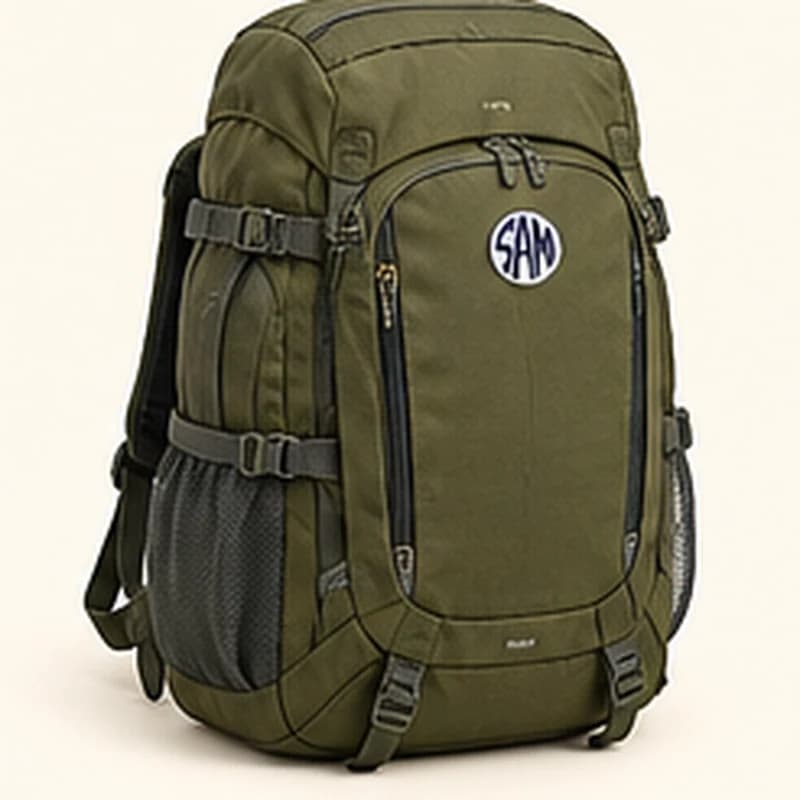
At its simplest, a backpack is a frameless fabric sack that sits on your back, held there by two shoulder straps. Your hands stay free and the load is shared across both shoulders. That's why hikers and students have relied on it for well over a century.
It goes by a lot of names. The Wikipedia entry on the backpack lists knapsack, rucksack, haversack and bookbag, and notes that hikers and students are the people who use backpacks most. Here in India, most of us just say school bag, college bag or laptop bag, depending on what's inside.
What really sets a backpack apart is how you wear it. You carry a tote in your hand or on one shoulder. A sling crosses your body on a single strap, and a duffel goes by its handles. A backpack rides on your back on two straps, so if you're carrying something heavy for a long time, it's the comfortable choice.
Where the word and the design come from
Every one of the backpack's names has a story behind it. Wikipedia, citing the Oxford English Dictionary, says the earliest known use of the word "backpack" is from 1896. Before then, and for a good while after, people mostly called it something else.
- Knapsack was the usual name for the bag right up to the mid 20th century.
- Rucksack is a German loanword, from Rücken or ruck, meaning "back".
- Haversack comes from the German Hafersack, an "oat sack", which hints that it was first used to carry food and supplies.
- Bookbag is just the everyday word for a backpack that carries school books.
The biggest design changes came with frames. The first external frame rucksack to get a patent was made by Henry Clay Merriam, a US Army officer, and introduced in 1887. It was duck canvas on a light steel frame.
In 1947 a hiker called Jack Abert designed a contoured aluminium external frame, shaped to follow the back. Then, in 1967, Greg Lowe invented the internal frame backpack. His design also brought in side compression straps, a modern sternum strap and load stabilisers. You'll still find all of those on a good travel or hiking backpack today.
What are the main types of backpacks?
Most backpacks share the same basic shape. But each type is tuned for a different job. Treat the capacity figures below as rough working guides, not fixed rules, since the right size really depends on what you carry.
| Type | Capacity guide | Key features | Best for |
|---|---|---|---|
| School backpack | Small to medium, sized to the class | Padded straps, several compartments, bottle pocket, reflective strips on some | Students from primary to senior school |
| College backpack | Medium, around 20 to 30 litres | Laptop or tablet sleeve, organiser pocket, smart look | Lectures, labs, daily commute |
| Laptop backpack | Medium, around 20 to 30 litres | Padded laptop compartment, charger pockets, slim profile | Office, remote work, client visits |
| Travel backpack | Large, around 35 to 45 litres | Wide opening, compression straps, sternum strap, hidden pocket | Weekend trips, cabin-only travel |
| Hiking backpack | Medium to large, depends on trip length | Frame or stiffened back, hip belt, load stabilisers, ventilated back | Treks, camping, long walks |
| Daypack | Small, around 15 to 25 litres | Light, simple, one or two compartments | Day outings, sightseeing, gym |
| Kids backpack | Small | Light build, bright prints, short straps | Pre-school and early primary |
| Anti-theft backpack | Medium | Hidden zips, back-facing pockets, cut-resistant panels on some | Crowded commutes, city travel |
You can browse every type in our collections: school backpacks, college backpacks, laptop backpacks, travel backpacks and hiking backpacks.
Frameless, external frame and internal frame
Wikipedia sorts backpacks into three categories: frameless, external frame and internal frame. A frame is there to move weight off your shoulders and down to your hips, which are far better at carrying a heavy load.
Frameless backpacks
This is the simple fabric sack with two shoulder straps. Nearly every school, college and laptop bag is frameless, and so is almost every daypack, sometimes with a foam back panel to give it some shape. It's light and flexible. For everyday loads of books, a laptop and a tiffin, it's all you need.
External frame backpacks
Here the bag hangs on a rigid frame that sits outside the fabric, like Merriam's steel frame from 1887 and Abert's later aluminium one. External frames handle big, awkward loads well and let air move across your back. They're bulky, though.
Internal frame backpacks
An internal frame pack hides its stiffening, such as stays or a frame sheet, inside the back panel. Since Greg Lowe's 1967 design it's become the usual pick for trekking and serious travel. Why? The pack hugs your body and stays steady on uneven ground.
Hip belt or shoulder straps: how a backpack carries weight
On a light everyday backpack, the shoulder straps take nearly all the weight. That's fine for a laptop and a few notebooks. With anything heavier, though, your shoulders and neck get tired fast.
Bigger packs fix this with a padded hip belt. According to Wikipedia, large packs and many sports packs carry up to about 90 percent of the weight on padded hip belts, and the shoulder straps are mostly there to keep the pack steady. A sternum strap across the chest stops the shoulder straps sliding outwards. Load stabiliser straps pull the top of the pack in close to your body.
With children, how much the bag weighs matters as much as how it's carried. As ThePrint reported, India's School Bag Policy 2020 suggests a school bag should weigh about 10 percent of the child's body weight. Our guide to school bag size by class shows you how to pick the right size.
What are backpacks made of?
The fabric decides how heavy a backpack is, how it copes with rain and how long it'll last. Here are the materials you'll come across most, in plain terms.
- Polyester is a light, affordable synthetic that holds colour well and prints nicely. It's the most common fabric in school and college backpacks.
- Nylon is another synthetic. It's smooth, strong for its weight and good at shrugging off scuffs, so you'll see it a lot on travel and hiking packs.
- Ripstop isn't a fibre, it's a weave. Ripstop fabric has a reinforcing grid woven in that resists tearing and stops small rips from spreading. It's usually made in nylon or polyester.
- Canvas is a heavy, plain-woven fabric, traditionally cotton. It looks classic and ages well, but it's heavier and slower to dry.
- A PU coating is a thin layer of polyurethane on the inside of the fabric that helps it keep water out. It's what stops light monsoon rain soaking straight through.
| Material | Feel and weight | Water resistance | Durability | Best for |
|---|---|---|---|---|
| Polyester | Light, smooth, holds colour | Fair, good with a PU coating | Good | School, college and everyday backpacks |
| Nylon | Light, slightly silky, strong | Fair, good with a PU coating | Very good, resists scuffing | Travel, laptop and hiking backpacks |
| Ripstop nylon or polyester | Light with a visible grid pattern | Good with a coating | Very good, resists tears spreading | Hiking, travel, heavy daily use |
| Canvas | Heavy, matte, natural feel | Low unless waxed or coated | Good, ages well | Casual and vintage-style backpacks |
| PU-coated fabric | Slightly stiffer on the inside | Good against light rain | Coating can wear over years | Monsoon commuting, school bags |
So what's the best backpack material? For most buyers in India, we'd go for a coated polyester or nylon, ideally in a ripstop weave. It gives you the best mix of weight, price and monsoon resistance. Canvas is a style choice more than a practical upgrade.
What does backpack capacity in litres mean?
Backpack capacity is given in litres, the volume of the main space plus the pockets. A bigger number means more room. It also means a bigger, heavier bag, and one that tempts you to overpack.
Roughly speaking, a small daypack takes a water bottle, a jacket and a snack. A mid-sized college or laptop backpack fits a laptop, a few notebooks, a charger and a tiffin, and a larger travel backpack holds a few days of clothes. Litre figures aren't fully standard between makers, though, so it's worth checking the dimensions and compartments as well.
If you carry a laptop, check the sleeve size too, not just the litres. Our laptop backpack buying guide goes through screen sizes and padding in detail.
How a backpack is made, step by step
A backpack has far more parts than a tote: panels, padding, straps, zips, pockets and binding. The order of work matters. Branding usually goes onto flat panels before the bag is assembled, because a flat panel sits evenly under a screen or an embroidery hoop.
- Design and pattern. The maker fixes the size, compartments, pockets, materials, colours and logo position, then draws a paper or digital pattern for every piece.
- Cutting the panels. Fabric is laid in layers and cut into front, back, side, base, pocket and strap pieces, plus foam for the padding.
- Printing or embroidery. The logo or artwork goes onto the flat panels by screen printing, heat transfer or embroidery.
- Back panel and padding. Foam or mesh-covered padding is stitched into the back panel. On laptop backpacks, this is when the padded laptop sleeve gets built.
- Shoulder straps. They're cut, filled with foam, stitched and fitted with webbing and adjustment buckles.
- Zips and pockets. Zips are sewn into the openings, and the front, side and inner pockets go on while the panels are still easy to get at.
- Assembling the body. Front, sides, base and back are stitched together, usually inside out, so the main seams end up inside the bag.
- Binding the seams. Raw inner seam edges get covered with binding tape so they don't fray and the inside looks neat.
- Bar tacks at the strap anchors. Wherever a strap or grab handle joins the bag, it's reinforced with bar tacks, dense rows of short zigzag stitches. The whole load pulls on those points.
- Inspection. Each bag is checked for stitching, zip action, strap strength and finish, then trimmed of loose threads and packed.
The zip gets used more than any other part, and it's also the part that fails most often. So it pays to pick a bag with smooth, strong zips. Wikipedia's entry on the zipper is a good primer on how they work, and for stitch and seam checks, have a look at how to identify a good quality bag.
How do you choose the right backpack?
One bag or several hundred, these are the things we'd check before buying.
- Start with the use. School, college, office, travel or treks? Pick the matching type, not a one-size-fits-all bag.
- Choose a size for what you carry every day, not the most you might ever carry.
- Look for padded, adjustable shoulder straps, plus a sternum strap or hip belt on bigger bags.
- Fabric and coating: coated polyester or nylon copes with the monsoon, and ripstop adds tear resistance.
- Open and close every zip a few times. They should run smoothly and not catch.
- Check for bar tacks where the straps meet the body, then give them a firm pull. Nothing should give.
Just buying one for yourself? You can buy backpacks online from us, with delivery across India.
Cleaning and caring for a backpack
- Empty it completely and shake out the crumbs and dust before you clean it.
- Spot clean marks with a soft brush, mild soap and cool water. Don't machine wash it unless the care label says you can, because it can damage the foam padding and the PU coating.
- Brush grit out of the zip teeth. Never force a stuck zip; ease it back and try again.
- Air dry it in the shade with every pocket open. In the monsoon, let it dry fully before you put it away, or you'll get mildew and smells.
- Store it somewhere dry, and not crushed under heavy things, so the padding keeps its shape.
How SAM makes, checks and supplies backpacks in bulk
Schools, coaching institutes and companies order backpacks in bulk for students, batches and staff. We've spent more than 10 years in bulk and wholesale bag supply, and we have over 1000 happy clients, including the coaching institutes ALLEN and Aakash. This is how a bulk backpack order works with us.
- Minimum order: bulk starts at 25 pieces. You can mix different products in one order and they all count together.
- We send a physical branded sample for you to approve before the full run.
- Branding can be embroidery, screen print, heat transfer, a woven or rubber patch, or a metal badge.
- Every piece is inspected for stitching, zips and finish before it leaves us.
- Dispatch is usually 7 to 21 days after you approve the sample, and we confirm it in the quote. Bulk orders come with a GST invoice, and one order can go to several addresses.
If you're a school planning for the April to June session, start with our school bags in bulk page. Colleges, coaching institutes and companies can head to college backpacks in bulk. Send us an enquiry and we'll reply within 1 working day.
Sources and further reading
- Backpack, Wikipedia
- Ripstop, Wikipedia
- Zipper, Wikipedia
- Govt suggests no homework up to Class 2, school bag should weigh 10% of body weight, ThePrint